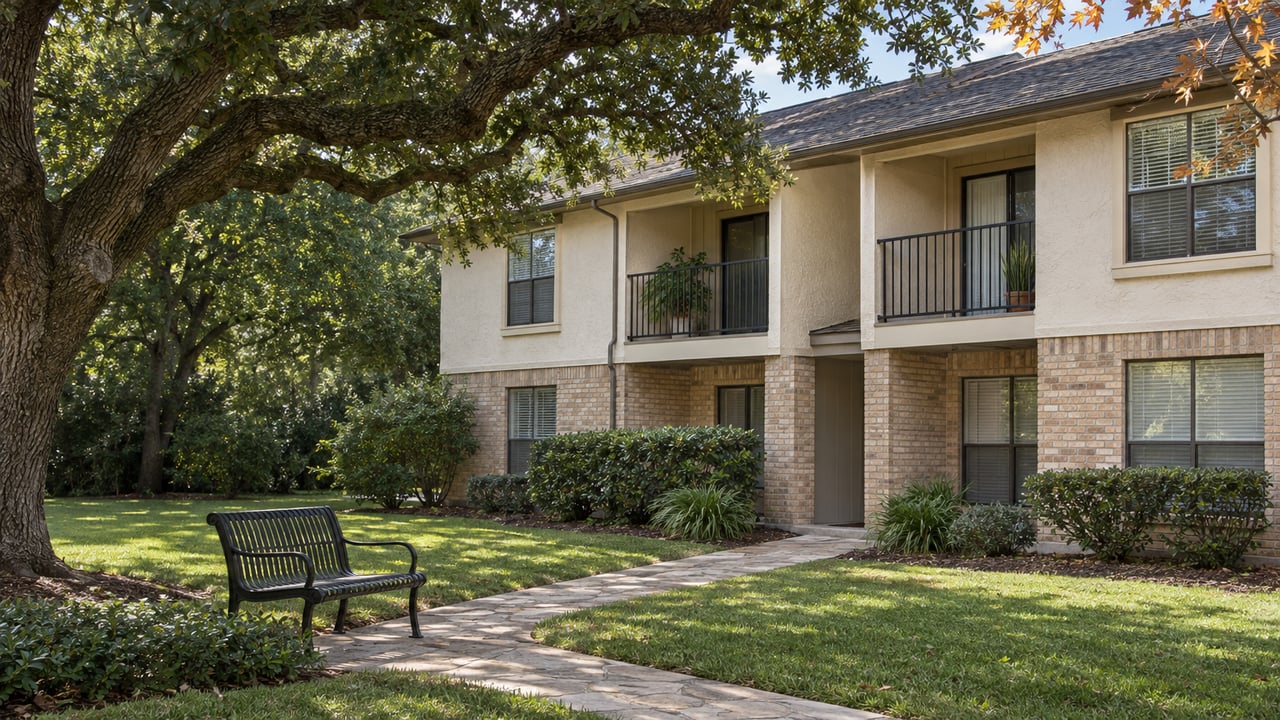
"They're struggling because they're not underwritten to operate at lower occupancies." That is how Ryan Baldwin, executive director of the San Antonio Apartment Association, described midrange and affordable apartment owners to the San Antonio Express-News in late August. The sentence applies to anyone who owns, or is pricing, an older rental in San Antonio. A building's budget decides how long it can wait for a tenant, and right now the newest buildings have the most money set aside for waiting.
That runs against the usual way small investors screen a rental market. The standard rule is to avoid submarkets with heavy new construction, because new supply competes for tenants. In Q3 2026, San Antonio's three submarkets with zero apartment units under construction were North Central, Northeast and Westside. Two of them had the highest vacancy rates in the metro, and all three were above the market average, according to Cushman & Wakefield's Q3 2026 multifamily report. When the city as a whole is oversupplied, older units feel the competition even if nothing is being built next door.
Lease-up reserves pay for the free month
New apartment complexes open with operating reserves meant to carry them through lease-up. During a glut, that money lets them buy occupancy. Baldwin made this point to the Express-News: luxury operators "have operating reserves for lease-up, so they can afford to give these concessions and play with rents a bit to get the units filled. They have that reserve built in that others don't have."
The numbers show where tenants went. As of Q2 2026, CoStar data reported by the Express-News showed four- and five-star apartments with vacancy below 12%, even though they make up 47% of local inventory. Midrange and affordable units were at 18%. The same article reported that many renters had moved from older apartments to newer ones across the metro.
Discounts are the tool doing the moving. In the Express-News report, data from Austin Investor Interests put average discounts and concessions at 9.3% of market rent, about $111 a month. Newer luxury properties were offering nearly 12%. A Class A unit discounted by 12% now competes with Class B units on price, and it brings a newer building and amenities along with the lower rent.
In Q2 2026, CoStar put average four-star rent at about $1,450 a month and the marketwide average at $1,250, down from $1,278 a year earlier. The gap between a four-star unit and the market average was about $200 a month, and the discounts at newer luxury buildings narrow that gap from the four-star side.
Where the empty units ended up in Q3
Cushman & Wakefield's Q3 2026 submarket table shows the result. Here are the submarkets that best show the pattern:
| Submarket, Q3 2026 | Units under construction | YTD net absorption | Stabilized vacancy | YoY effective rent |
|---|---|---|---|---|
| Westside San Antonio | 0 | -152 | 20.5% | -0.6% |
| North Central San Antonio | 0 | -284 | 18.4% | +0.7% |
| Southeast San Antonio | 353 | 366 | 17.7% | -1.4% |
| Northeast San Antonio | 0 | 261 | 15.0% | -5.4% |
| Far West San Antonio | 740 | 1,379 | 12.7% | -3.1% |
| Northwest San Antonio | 635 | 600 | 12.5% | -3.9% |
| Total market | 3,993 | 5,029 | 13.9% | -3.5% |
Westside and North Central were the only two submarkets in the metro with negative year-to-date absorption. Both had no construction in progress, so their losses came from tenants leaving existing units. Far West, by contrast, had 740 units under construction and led the metro in absorption with 1,379 units, and its vacancy stayed below the market average.
North Central also shows why a rent comp alone can mislead. It was the only submarket with positive year-over-year effective rent growth, at 0.7%, to an average of $1,146. In the same period it lost 284 occupied units and had 18.4% of its stabilized stock vacant. Leased units there are holding their rent. A rent survey reports what those units earn and does not show how many units are empty.
New supply does still matter. Southeast San Antonio delivered 864 units through Q3, the most of any submarket, and vacancy there stood at 17.7%. High vacancy shows up in two places: submarkets taking in new buildings, and submarkets whose older stock is losing tenants to new buildings elsewhere. A lack of nearby cranes protects only against the first.
The metro is recovering, and the newest buildings fill first
The metro-level trend is positive. In Q3 2026, San Antonio absorbed 1,497 apartment units against 677 delivered, the second straight quarter in which absorption beat new supply. Deliveries were the lowest for any quarter since at least 2021. Units under construction fell to 3,993, down 31.7% year over year. Average effective rent was $1,148, and the year-over-year decline narrowed to 3.5%.
The San Antonio Report laid out the timeline in September. Baldwin estimated about 5,000 new units for 2026, less than half the 2024 total, and analyst Khalil put 2027 completions near 2,000. CoStar figures in the same story show vacancy falling from 16% at the start of 2026 to 14.9% in the third quarter. Khalil expected landlords to stop offering concessions and possibly raise rents again in late 2027 and early 2028. For now, Apartments.com's Q3 RentPulse release from October 28 describes Texas as a market where significant discounts are still available even as leasing picks up and vacancies begin to decline.
The order of the recovery matters for small owners. Baldwin told the Express-News that absorption catching up "is going to happen first in the luxury market." In the San Antonio Report, he said the downturn hits smaller, local landlords hardest, because large institutional owners can absorb losses and newer properties attract tenants more easily. Older units in Westside and North Central are likely to see the recovery after newer buildings do.
The same pattern in houses and fourplexes
Rental houses are not directly comparable to garden apartments, but October 2026 MLS rental data compiled by Hendricks Property Management for San Antonio proper moved in a similar way. Single-family asking rents were almost unchanged from a year earlier, at $1,970 compared with $1,966. Average days on market rose from 58 to 64. The average rented price rose from $1,844 to $1,876, and the number of homes rented fell from 719 to 704. That report counts houses and garden homes as single-family and groups duplexes, triplexes and fourplexes as multifamily.
The direction matches the apartment pattern, with asking rents holding and homes taking longer to lease. For a small investor, an extra week of vacancy each turnover is a cost that the asking rent does not show.
Who is buying older complexes, and what is still coming
Larger buyers are already acting on the recovery timeline. Through the first three quarters of 2026, Cushman & Wakefield counted 29 multifamily sales totaling 4,980 units, a 7.4% rise in transaction count over the same period of 2025. Buyers were increasingly targeting assets positioned to benefit as supply and demand improve. The recent sales it highlighted were all older properties, several in high-vacancy submarkets:
- Westwood Plaza, Westside San Antonio, 308 units, built 1960
- SkyVue, Northwest San Antonio, 232 units, built 1978
- Winston Square, Southwest San Antonio, 120 units, built 1972
- The Selena, Southeast San Antonio, 119 units, built 1975
Buyers of older stock are betting that the shortage of new deliveries in 2027 will eventually send tenants back to them. The pipeline Cushman & Wakefield lists shows which new buildings are scheduled to begin leasing in the meantime:
- Lucia at Brooks, The NRP Group, 353 units, Southeast San Antonio, estimated Q1 2027
- Creek Bend Apartments, Pedcor Companies, 312 units, North San Antonio, estimated Q2 2027
- Lily Springs, Lightpath Company, 282 units, Guadalupe County, estimated Q2 2027
- Tower Life, McCombs Enterprises, 243 units, Downtown San Antonio, estimated Q3 2027
Lucia at Brooks is expected in a submarket that already had 17.7% vacancy in Q3. Creek Bend is expected in North San Antonio, where effective rents were down 4.8% year over year. Both are scheduled to lease up in 2027, ahead of the late-2027 to early-2028 window analysts gave the San Antonio Report for concessions to fade.
Questions small investors ask about this market
Does a submarket with no new construction mean less competition for my rental? Not in Q3 2026. North Central, Northeast and Westside had zero units under construction and vacancy of 18.4%, 15.0% and 20.5%, compared with 13.9% metrowide.
Which buildings recover first when concessions end? According to Baldwin's comments to the Express-News, the luxury segment is absorbing renters first. Its four- and five-star units were already below 12% vacancy in Q2 2026.
When are concessions expected to fade? Analysts quoted by the San Antonio Report pointed to late 2027 into early 2028. Apartments.com's October 2026 release still described significant discounts across Texas.
If you are pricing a duplex in North Central or a small complex on the Westside, check how long its units are taking to lease and what discounts nearby Class A buildings are offering, not only the rent comps. The Abrahams Real Estate TIES Team works with investors, builders and commercial clients across San Antonio. Book a consultation to look at your submarket's vacancy and absorption figures before you make an offer, or request a free valuation on a rental you already own.